Lo que el gobierno mexicano debió haber logrado
🛑 Justicia penal internacional
Exigir verdad significa obligar a Egipto a reconocer públicamente qué hizo, cómo lo hizo, quién lo ordenó y por qué ocurrió. Y eso, para un Estado autoritario, es profundamente incómodo porque abre puertas que hoy mantiene cerradas.
A partir de ahí, desgloso lo que debería significar para Egipto si la exigencia se tomara en serio.
La verdad implica que Egipto deje de sostener la narrativa falsa de “operación antiterrorista legítima”. Significa que el Estado:
admita que atacó un convoy autorizado
reconozca que las víctimas eran turistas desarmados
acepte que hubo uso ilegítimo y desproporcionado de la fuerza
Este reconocimiento es el punto cero de cualquier proceso de justicia.
La verdad exige que Egipto abra los expedientes que hoy oculta:
reportes de inteligencia previos al ataque
órdenes operativas y cadena de mando
bitácoras de vuelo y comunicaciones militares
informes internos de investigación
decisiones judiciales finales (que siguen sin entregar)
Sin esa información, no hay verdad verificable.
La verdad no es solo “qué pasó”, sino quién lo hizo. Para Egipto, esto implicaría:
identificar a los mandos que autorizaron la operación
identificar a quienes ejecutaron el ataque
revelar fallas de inteligencia y negligencias
reconocer encubrimientos posteriores
Esto es lo que el régimen militar más teme.
La verdad también implica que Egipto acepte:
que hubo víctimas civiles
que el ataque fue injustificado
que el Estado causó un daño irreparable a familias mexicanas
que mintió en su narrativa oficial
Este reconocimiento es la base ética de cualquier reparación.
La verdad obliga a Egipto a admitir que violó:
el derecho internacional humanitario
el derecho a la vida
el deber de distinguir entre civiles y combatientes
el deber de investigar y sancionar
Aceptar esto abre la puerta a obligaciones jurídicas que Egipto quiere evitar.
La verdad significaría que el ejército egipcio —pilar del régimen— acepte que cometió un error grave. Eso implicaría:
sanciones internas
reformas operativas
supervisión civil
límites al poder militar
Para un régimen autoritario, esto es una amenaza directa.
La verdad obliga a Egipto a permitir:
observación independiente
cooperación con organismos internacionales
revisión de sus protocolos de seguridad
diálogo con las víctimas
Egipto evita esto porque debilita su control narrativo.
La verdad implica admitir que:
la versión oficial fue falsa
se ocultó información
se manipuló la narrativa
se negó justicia deliberadamente
Este es un costo político que el régimen no quiere pagar.
PALAIS DES NATIONS 1211 GENEVA 10, SWITZERLAND
Mandates of the Special Rapporteur on the promotion and protection of human rights and fundamental freedoms while countering terrorism; and the Special Rapporteur on torture and other cruel, inhuman or degrading treatment or punishment
REFERENCE:
AL EGY 5/2020
25/05/24 18:00:00
1 July 2020
Excellency,
We have the honour to address you in our capacities as Special Rapporteur on the promotion and protection of human rights and fundamental freedoms while countering terrorism; and Special Rapporteur on torture and other cruel, inhuman or degrading treatment or punishment, pursuant to Human Rights Council resolutions 40/16 and 34/19.
In this connection, we would like to bring to the attention of your Excellency's Government information we have received concerning the alleged arbitrary killing of Rafael José Rangel, Vanessa Ramírez Letechipia, Israel González Delgadillo, María Elena Cruz Muñoz, María de Lourdes, Fernández Rubio, Lilia Gabriela Chávez Overhage, Rosa Marisela Rangel Dávalos, Gretel Overhage Chávez, and severe injury of Juan Pablo García Chávez, as a result of action taken during a counterterrorism operation in Bahariya Oasis. In addition, we bring to your Excellency's attention deficits in investigation of these deaths, as well as a lack of independent and sufficient judicial proceedings capable of ascertaining legal responsibility for these deaths, which do not appear to have fulfilled the most stringent guarantees of fair trial and due process standards.
According to the information received:
According to the information received, on 13 September 2015, 10 tourists Rafael José Rangel, Vanessa Ramírez Letechipia, Israel González Delgadillo, María Elena Cruz Muñoz, María de Lourdes, Fernández Rubio, Lilia Gabriela Chávez Overhage, Rosa Marisela Rangel Dávalos, Gretel Overhage Chávez, and Juan Pablo García Chávez travelled towards Bahariya Oasis, in western Egypt as part of an organized tour to the area. Other individuals of Mexican, Egyptian and U.S nationality were also present in the tourist group. A registered private company, Windows of Egypt, with authorization issued by the Ministry of Tourism, organized the tour.
According to information received, the group was going to be transported in a bus. However, due to a mechanical breakdown the group had to change the logistics and means of mobilization, opting for four vehicles (three off-road trucks and a "Hummer"). Reportedly, the Egyptian authorities were duly notified of the change. The group was accompanied by a member of the Egyptian Tourist Police.
On the same day, the Ministry of the Interior informed the Armed Forces about the presence of alleged terrorists and a deposit of weapons, ammunition, and explosives in the area of the Al-Wahat Oasis.
On their way to Bahariya, the tourists went through at least one checkpoint of the Military Forces. At 3.15 p.m., the victims stopped for lunch in an open space, 2 km away from km 265 of the route Cairo - Bahariya Oasis. Without warning, from information conveyed it appears that Egyptian military forces saw the group, activated an air strike with bombs and machine guns, against the group.
The victims tried to find shelter behind and underneath the vehicles. Military helicopters flew over the camp, shooting several bursts of ammunitions, while the bombs from the airplanes continued dropping, until the vehicles protecting the survivors exploded. The tactic of the air strike appears to have involved attacking the tourist convoy of the four squared-form-parked vehicles to force the victims to flee from their improvised shelter. In parallel, the Army launched rockets or missiles against the vehicles, then, the helicopter passed by with machine-guns, shooting people running out of the vehicle shelters. The attack lasted for a total of approximately one hour, with three rounds of strikes that, according to information received, repeated the same tactic. Nonetheless, after the second strike, the Army apparently also released toxic chemical gases that deeply burned the victims' skin, producing sustained itching, as well as a reported sensation of internal burning of the organs.
Six of the victims were killed with massive injuries, including dismemberments, multiple gunshot wounds to their vital organs, complete carbonization among other physical affectations as a direct consequence of the armed attack by Egyptian forces. Likewise, the four surviving victims presented burns, fractures and organ perforation, and were found lying in the sand, unable to move.
At no time did the tourist group evidence any resistance or threat to the Egyptian military forces. They made gestures indicating that they required help, but the attacks continued regardless.
One of the group's drivers managed to escape the attack in order to seek help and warned the nearest police officers. Following the attack, no medical aid or support was provided to the dead or injured for at least three hours. Due to the delay in arriving at the hospital, one of the victims died on route.
On the same day of the attack, the Egyptian Ministry of Interior released a letter reporting that a tourist convoy had been mistakenly targeted during a joint police and armed forces operation against "some terrorist elements" in the oases located in the west part of the Sahara Desert.' The Egyptian Minister of Foreign affairs
2
released an open letter that stated that an anti-terrorist operation was taking place in the area at the same time as the convoy was passing through it. This letter also indicated that it was unknown whether the tourist convoy had the necessary permits, whether it had taken a detour into a restricted area, and whether the use of 4 wheel drives rather than a tourist bus had increased the risk of mistaken identification.2
The Egyptian General Prosecutor of the Military opened an investigation to examine the causes and circumstances of the incident, apparently to ascertain why a tourist convoy was allegedly travelling in a "no-go" zone. The Prosecutor of the Military apparently made inquiries to agents of the Armed Forces, the Department of Intelligence and Border Security as well as the General Directorate of the Tourism Police. He also interviewed survivors, employees and owners of the tourism company. From the investigation and the autopsies carried out, it appears that the Prosecutor demonstrated a causal relationship between the attack by the Egyptian military forces and the deaths of the victims, injuries and harm caused to the survivors. Even though state authorities acknowledged that there was a coordination problem among Egyptian officials that led to the attack, the Prosecutor concluded the officers were not individually legally liable because they were following superior orders, and decided to send the case to the Office of the Egyptian General Prosecutor in order to determine the responsibility of the owner of the tourism agency.
The Office of the Egyptian General Prosecutor subsequently opened a criminal proceeding against the owner of the tourism agency and one of the drivers who was part of the convoy. On 6 June 2017, the Court for Minor Crimes of the Bahariya Oasis issued a ruling deciding that the owners of the tourism agency had no criminal responsibility for the deaths and injuries. This decision was appealed and concluded with the decision of dismissal of the case by the Al Haram Criminal Court of Appeals. Participation of the victims or their families in the process was not permitted, because in accordance with the Egyptian legal system, foreign citizens cannot be considered as parties to domestic legal proceedings. The prosecution's accusation focused exclusively on the violation of Military Order No. 5 of 1984 by tourism companies, which refers to the presence of foreigners in some areas of the country. In addition, at a hearing on 7 March 2017, the judge in charge denied the request to incorporate new defendants, as well as the entire military investigation.
Without making a judgment as to the accuracy of the information made available to us, we would like to express our most serious concern about the deadly attack which extinguished and endangered the lives of the above-mentioned individuals, mistaken as alleged 'terrorist(s)' by your Excellency's Government. Based on the information received, there is no evidence that the State took any measures to verify, prior to the attack, the identities of the persons they were targeting, with a subsequent failure to identify the civilian status of the victims, and with a lack of due diligence in operation planning. Moreover, during the course of an apparently lengthy and deadly assault in which no resistance or action was taken by those targeted, the use of force continued excessively and without restraint, which would imply that there was no attempt to bring persons (mistakenly) suspected of criminal activity into custody and subject them to a rule of law based process. Thus, the conduct of the operation would appear to have proceeded without due regard for the protection of the right to life of those targeted, and thus constitute arbitrary deprivation of life.3 We also express concerns as to the adequacy of investigative, trial and remedial processes for the victims especially considering that the investigation did not yield information on which agency holds responsibility,+ nor seek to address if there was excessive use of force by individuals during the course of the operation. We also wish to express concern regarding attempts to deny the victims a fair compensation, until the present date, for the acts undertaken by state actors, leaving victims without access to justice for the violations they suffered, in an attempt to block other legal remedies to the victims. Should this information be proven accurate, these attacks may amount to arbitrary executions and cruel, inhuman and degrading treatment under international law.
We appeal to your Excellency's Government to act in accordance with international standards and take full responsibility for the above-mentioned military action.
We would also like to underline that a purely security-based approach to counterterrorism is inadequate and sometimes counterproductive. This position has been confirmed by the United Nations Security Council in inter alia UN Security Council Resolution 13735. The protection of human rights and particularly the right to life must be central to any effective counter-terrorism strategy and the United Nations as a whole is now formally committed to mainstreaming human rights protections throughout its counter-terrorism initiatives. As the General Assembly noted in resolution 72/284 adopting the United Nations Global Counter-Terrorism Strategy, effective counter- terrorism measures and the protection of human rights are not conflicting goals, but complementary and mutually reinforcing. Moreover, as Egypt is a party to the International Covenant on Civil and Political Rights and the Convention against Torture, actions taken by the military and police must be in conformity with its treaty obligations.
Human Rights Committee, General Comment No. 36 (2018) on article 6 of the International Covenant on Civil and Political Rights, on the right to life, CCRP/C/GC/36 para 12, "The notion of "arbitrariness" is not to be fully equated with "against the law", but must be interpreted more broadly to include elements of inappropriateness, injustice, lack of predictability, and due process of law ... as well as elements of reasonableness, necessity, and proportionality
66
Human Rights Committee, General Comment No. 36 (2018) on article 6 of the International Covenant on Civil and Political Rights, on the right to life, CCRP/C/GC/36 para 27 "An important element of the protection afforded to the right to life by the Covenant is the obligation on the States parties, where they know or should have known of potentially unlawful deprivations of life, to investigate and, where appropriate, prosecute such incidents including allegations of excessive use of force with lethal consequences'.
Reaffirming its resolutions 1269 (1999), “Emphasizing the necessity to intensify the fight against terrorism at the national level and to strengthen, under the auspices of the United Nations, effective international cooperation in this field on the basis of the principles of the Charter of the United Nations and norms of international law, including respect for international humanitarian law and human rights."
4
In view of the importance of the matter, we would appreciate a response on the steps taken by the Government of Egypt to safeguard the rights of the above-mentioned persons, or their surviving relatives, in compliance with its obligations under international law.
In connection with the above alleged facts and concerns, please refer to the Annex on Reference to international human rights law attached to this letter which cites international human rights instruments and standards relevant to these allegations.
As it is our responsibility, under the mandates provided to us by the Human Rights Council, to seek to clarify all cases brought to our attention, we would be grateful
your
observations on the following matters:
for
have on the above-mentioned allegations.
نه
Please provide information on each stage of the judicial proceedings against the officers responsible for the attacks on the above-mentioned individuals and indicate how they comply with Egyptian and international law standards in particular guarantees related to the right to fair trial and due process.
5.Please provide any information regarding a reparations program in which, together with the compensation, the four other major forms of reparation: restitution, rehabilitation, satisfaction measures and guarantees of non- repetition, noting that the reparation must be proportional to the seriousness of the violations and the damage suffered.
6.Please provide information in regard to Egypt's previous commitment to publicly recognise its international responsibility and assure the victims and their family members adequate and free medical and psychological treatment.
7.Please provide information about how all measures taken by your Excellency's government to combat "terrorism" and "violent extremism," including incitement of and support for "terrorist acts", comply with Egypt's obligations under international law, in particular international human rights law, refugee law, humanitarian law, and the relevant provisions of United Nations Security Council resolutions 1373 (2001), 1456(2003), 1624 (2005), 2178 (2014), 2341 (2017), 2354 (2017), 2368 (2017) and 2370 (2017); as well as Human Rights Council resolution 35/34 and General Assembly resolutions 49/60, 51/210, 72/123 and 72/180.
We would appreciate receiving a response within 60 days. Passed this delay, this communication and any response received from your Excellency's Government will be made public via the communications reporting website. They will also subsequently be made available in the usual report to be presented to the Human Rights Council
While awaiting a reply, we urge that all necessary interim measures be taken to halt the alleged violations and prevent their re-occurrence and in the event that the investigations support or suggest the allegations to be correct, to ensure the accountability of any person(s) responsible for the alleged violations.
A copy of this letter will be sent to Mexico.
Please accept, Excellency, the assurances of our highest consideration.
Fionnuala Ní Aoláin
Special Rapporteur on the promotion and protection of human rights and fundamental freedoms while countering terrorism
Nils Melzer
Special Rapporteur on torture and other cruel, inhuman or degrading treatment or punishment
6
Annex
Reference to international human rights law
The facts alleged indicate a prima facie violation of the rights to life and not to be arbitrarily be deprived of life, the right to liberty and security, the right to be free from cruel, inhuman and degrading treatment, and the right to a fair trial by an independent and competent court, as set forth in articles 6, 7, 9, and 14 of the International Covenant on Civil and Political Rights (ICCPR), as well as article 16 of the Convention against Torture and Other Cruel, Inhuman and Degrading Treatment or Punishment (CAT). Both treaties were ratified by Egypt on 14 January 1982 and 25 June 1986 respectively.
Even in the case where these persons may have been mistaken to have been terrorists, we remind your Excellency's Government that the lawful use of lethal force must be guided by and in full adherence of the use of force principles i.e. legality (any use of force must have a legal basis and pursue a lawful purpose), necessity (force must only be used when, and to the extent, strictly necessary for the achievement of a lawful purpose), proportionality (the harm likely to be inflicted by the use of force must not be excessive compared to the benefit of the lawful purpose pursued) and precaution (law enforcement operations must be planned, prepared and conducted so as to minimize, to the greatest extent possible, the resort to force and, whenever it becomes unavoidable, to minimize the resulting harm) in accordance with Basic Principles on the Use of Force and Firearms by Law Enforcement Officials and the Code of Conduct for Law Enforcement Officials.
The prohibition of cruel, inhuman or degrading treatment is absolute and non- derogable under international law. The prohibition includes any use of force that does not pursue a lawful purpose, or that causes unnecessary or disproportionate harm (A/72/178). The prohibition has also been included in article 3 common to the Geneva Conventions of 12 August 1949, which the International Court of Justice has held to reflect a general principle of law, namely "elementary considerations of humanity" (Nicaragua v. United States of America, ICJ Reports 1986, pp. 14).
We would like to further bring to the attention of your Excellency's Government the right to a remedy for victims pursuant to article 13 of the CAT. In this context, we would also like to draw the attention of your Excellency's Government to paragraph 7 b and e of Human Rights Council Resolution 16/23 adopted in April 2011, which urges States "(t)o take persistent, determined and effective measures to have all allegations of...cruel, inhuman or degrading treatment or punishment investigated promptly, effectively and impartially by an independent, competent domestic authority, as well as whenever there is reasonable ground to believe that such an act has been committed; to hold persons who encourage, order, tolerate or perpetrate such acts responsible, to have them brought to justice and punished in a manner commensurate with the gravity of the offence...; and to take note, in this respect, of the Principles on the Effective Investigation and Documentation of Torture and Other Cruel, Inhuman or Degrading Treatment or Punishment and the updated set of principles for the protection of human rights through action to combat impunity as a useful tool in efforts to prevent and combat
7
torture," and "(t)o ensure that victims of...cruel, inhuman or degrading treatment or punishment obtain redress, are awarded fair and adequate compensation and receive appropriate social, psychological, medical and other relevant specialized rehabilitation."
La responsabilidad internacional del Estado es un régimen jurídico consolidado que determina cuándo un Estado debe responder por un hecho ilícito, reparar integralmente y garantizar no repetición. Su marco principal son los Artículos sobre Responsabilidad del Estado por Hechos Internacionalmente Ilícitos (ARSIWA) de la Comisión de Derecho Internacional (CDI), considerados derecho consuetudinario.
Apliquemos los elementos técnicos al caso del ataque contra turistas mexicanos en 2015.
1.1. Atribución
Un hecho es atribuible al Estado cuando es cometido por:
Órganos del Estado (art. 4 ARSIWA)
Fuerzas armadas (art. 4 y 7)
Agentes que ejercen funciones públicas (art. 5)
En el caso egipcio:
El ataque fue realizado por fuerzas de seguridad y fuerzas armadas.
Por tanto, la atribución es directa y automática.
No importa si actuaron por error, negligencia o exceso: siguen siendo órganos del Estado.
👉 Técnicamente, Egipto no puede alegar “confusión” para evitar atribución.
1.2. Violación de una obligación internacional
Un Estado incurre en responsabilidad cuando incumple una obligación internacional vigente para él (art. 12 ARSIWA).
En este caso, las obligaciones relevantes incluyen:
a) Derecho internacional de los derechos humanos
Derecho a la vida
Prohibición de uso arbitrario de la fuerza
Deber de investigar
Deber de reparar
b) Derecho internacional del turismo y protección de extranjeros
Los Estados deben:
Garantizar seguridad a turistas
Proteger a extranjeros bajo su jurisdicción
Evitar uso indiscriminado de fuerza en zonas civiles
c) Derecho internacional humanitario (si alegan “operación antiterrorista”)
Incluso en operaciones armadas:
Debe respetarse el principio de distinción
Prohibición de ataques contra civiles
Proporcionalidad
Precauciones en el ataque
👉 El convoy turístico estaba autorizado y en zona permitida. La violación es objetiva.
Una vez configurada la responsabilidad, el Estado tiene tres obligaciones (arts. 30–31 ARSIWA):
2.1. Cese y garantías de no repetición
Reconocer el hecho
Investigar
Sancionar responsables
Ajustar protocolos militares y turísticos
Egipto no cumplió plenamente con ninguna.
2.2. Reparación integral
La reparación debe ser completa (art. 31), e incluye:
a) Restitución
No aplicable en casos de muerte.
b) Indemnización
Debe cubrir:
Daño material
Daño moral
Lucro cesante
Gastos médicos
Daños a sobrevivientes
Egipto ofreció compensaciones parciales, sin admisión de responsabilidad.
c) Satisfacción
Incluye:
Disculpa formal
Reconocimiento público
Investigación transparente
Memoriales o medidas simbólicas
Egipto evitó la disculpa y minimizó la admisión de culpa.
👉 La reparación sin reconocimiento no cumple estándares internacionales.
No.
Los ARSIWA son claros:
La intención no es relevante para la existencia de responsabilidad.
Un “error operativo” sigue siendo un hecho ilícito atribuible al Estado.
La única excepción sería legítima defensa o fuerza mayor, pero ninguna aplica aquí.
La responsabilidad existe objetivamente, aunque el Estado no la acepte.
Pero políticamente, la negativa tiene efectos:
Dificulta mecanismos de solución amistosa
Impide reparación integral
Bloquea garantías de no repetición
Reduce transparencia
Aumenta impunidad
En términos jurídicos, la negativa no elimina la obligación, solo la incumple.
5.1. Vías diplomáticas
Protesta formal
Negociación bilateral
Comisión mixta de investigación
Acuerdos de compensación
México optó por esta vía, con resultados limitados.
5.2. Vías internacionales
Comité de Derechos Humanos (si se argumenta violación del PIDCP)
Relatores especiales de la ONU
Consejo de Derechos Humanos
Procedimientos especiales sobre ejecuciones extrajudiciales
Examen Periódico Universal (EPU)
5.3. Vías contenciosas
Difíciles porque:
Egipto no acepta jurisdicción obligatoria de la CIJ
No hay tratado bilateral que permita arbitraje
Las víctimas individuales no pueden demandar directamente a un Estado extranjero ante tribunales internacionales sin consentimiento
Desde el punto de vista jurídico, Egipto incurrió en un hecho internacionalmente ilícito por:
Uso arbitrario de la fuerza
Muerte de civiles extranjeros
Falta de investigación adecuada
Falta de reparación integral
La responsabilidad existe independientemente de que Egipto la reconozca. Lo que hace el Estado es evitar las consecuencias jurídicas y políticas de esa responsabilidad.
Las relatorías especiales forman parte de los Procedimientos Especiales del Consejo de Derechos Humanos. Son expertos independientes que investigan, monitorean y formulan recomendaciones a los Estados sobre situaciones de derechos humanos.
⚖️ Sus recomendaciones no son legalmente vinculantes
Los Estados no están obligados jurídicamente a cumplirlas. No existe un mecanismo coercitivo que obligue a un país a acatar una recomendación de una relatoría.
Sin embargo, eso no significa que no haya consecuencias.
Consecuencias reales cuando un Estado ignora una recomendación
Las relatorías informan públicamente sobre el comportamiento de los Estados. Ignorar recomendaciones puede:
Los procedimientos especiales pueden:
Aunque no es automático, el incumplimiento puede influir en:
El incumplimiento puede ser retomado por:
Esto genera un efecto acumulativo: el país aparece repetidamente como renuente a cooperar.
Si el Estado no solo ignora, sino que hostiga o toma represalias contra quienes cooperan con las relatorías, la ONU puede activar mecanismos específicos de denuncia de represalias.
¿Por qué aun así importan las recomendaciones?
Porque:
En la práctica, muchos cambios legislativos o de política pública en el mundo han surgido no por obligación, sino por la fuerza moral, política y técnica de estas recomendaciones.
El caso de los turistas mexicanos en Egipto hubo una recomendación de las relatorías de la ONU por tortura y ejecuciones extrajudiciales para el estado egipcio exigiendo una disculpa y reparación integral del daño
En 2020, dos Procedimientos Especiales de la ONU —la Relatora Especial sobre la lucha contra el terrorismo y el Relator Especial sobre la tortura— enviaron una Carta de Alegaciones al Estado egipcio por el ataque militar que mató y lesionó gravemente a turistas mexicanos en el desierto de Bahariya en 2015.
La carta concluyó que hubo:
📌 ¿Qué exigieron las relatorías al Estado egipcio?
Según los reportes basados en la carta oficial:
✔️ 1. Reconocimiento de responsabilidad
Los expertos de la ONU señalaron que el argumento de Egipto —que los turistas fueron confundidos con terroristas— no era aceptable, pues no hubo verificación previa ni intento de detención.
✔️ 2. Disculpa pública
La carta de alegaciones pidió que Egipto reconociera públicamente el error y ofreciera una disculpa a las víctimas y sus familias.
✔️ 3. Reparación integral del daño
Incluyendo:
La prensa mexicana y organizaciones de derechos humanos han reiterado que hasta la fecha no existe reparación integral ni disculpa oficial por parte de Egipto.
¿Qué DEBERÍA pasar si Egipto no cumple con la recomendación?
🔹 1. Mayor escrutinio internacional
El caso puede ser retomado en:
🔹 2. Señalamientos públicos
Los expertos pueden incluir a Egipto en informes anuales por falta de cooperación o incumplimiento.
🔹 3. Presión diplomática
Otros Estados pueden usar estas conclusiones para exigir explicaciones o condicionar cooperación.
🔹 4. Fortalecimiento de la incidencia de víctimas y sociedad civil
La carta de alegaciones es un documento oficial de la ONU que reconoce violaciones graves. Esto tiene un peso enorme en litigio estratégico, campañas de memoria y exigencia de justicia.
No: Egipto no ha cumplido.“No fue un accidente. Fue una violación grave de derechos humanos reconocida por la ONU.”
Un litigante en derechos humanos debe combinar conocimiento jurídico sólido, habilidades de comunicación y negociación, y sobre todo una convicción ética y compromiso con la justicia.
Cualidades esenciales de un litigante en derechos humanos
En el contexto de derechos humanos
Un litigante en esta área no solo defiende a un cliente, sino que representa causas colectivas y busca sentencias que sienten precedentes. Por ello, además de las habilidades técnicas, debe tener:
Un litigante en derechos humanos debe ser jurista, comunicador, estratega y defensor ético, con la resiliencia necesaria para enfrentar procesos complejos y la pasión de convertir cada caso en un paso hacia la justicia.
Comparativo de perfiles
Litigante Tradicional Litigante en Derechos Humanos
Objetivo principal
Defender intereses particulares de un cliente (patrimoniales, Defender la dignidad humana, visibilizar violaciones y buscar
contractuales, penales). precedentes que beneficien a comunidades Ámbito de acciónTribunales nacionales, procedimientos civiles, mercantiles, penales. Tribunales nacionales e internacionales (Corte Interamericana, ONU, comités especializados).
Narrativa jurídica
Centrada en hechos y pruebas del caso concreto. Integra testimonios, contexto social y patrones de violaciones sistemáticas.
Ética profesional
Cumplir con deberes de representación y confidencialidad. Actuar con integridad, evitando revictimización y priorizando la voz de las víctimas.
Habilidades clave
Técnica procesal, negociación, conocimiento normativo. Sensibilidad cultural, resiliencia emocional, incidencia política y social.
Impacto esperado
Resolución favorable para el cliente. Transformación social, reparación simbólica y creación de jurisprudencia protectora.
Relación con la comunidad
Generalmente limitada al cliente. Cercana a colectivos, organizaciones y movimientos sociales.
Estrategia
Ganar el caso en términos legales. Usar el caso como herramienta de memoria, justicia y prevención.
Rasgos distintivos del litigante en derechos humano
Empatía y sensibilidad cultural: comprender las realidades de comunidades vulnerables.
Resiliencia emocional: sostener procesos largos y desgastantes.
Capacidad de incidencia internacional: articular casos locales con organismos globales.
Visión estratégica: transformar litigios en precedentes y campañas de memoria.
La Comisión Africana de Derechos Humanos y de los Pueblos (CADHP) es el principal órgano de la Unión Africana encargado de promover y proteger los derechos humanos en el continente africano. Fue establecida en 1986 mediante la Carta Africana sobre Derechos Humanos y de los Pueblos, también conocida como la Carta de Banjul.
Estructura y Mandato
Procedimientos y Mecanismos
Actualidad
En octubre de 2025, durante su 85º periodo ordinario de sesiones, la CADHP eligió como nuevo presidente al Comisario Idrissa Sow (África Occidental) y como vicepresidente al Comisario Hatem Essaiem (África del Norte), quienes servirán por dos años.
8 oct 2025 12:16
🛑 Justicia penal internacional
7 oct 2025 18:41
🌍 La obligación de los gobiernos de proteger a sus ciudadanos en el extranjero se fundamenta en el derecho internacional, la práctica consular y los principios de derechos humanos. Esta responsabilidad no es solo moral, sino también jurídica, y se expresa en múltiples instrumentos legales y diplomáticos.
6 oct 2025 18:34
Organismos en México
3 oct 2025 18:28
Los Derechos Humanos son el conjunto de libertades, garantías y prerrogativas inherentes a todas las personas por el simple hecho de ser humanas. No dependen de nacionalidad, género, religión, orientación política o cualquier otra condición. Son universales, inalienables, interdependientes e indivisibles.
24 sept 2025 12:25
23 sept 2025 14:12
“Hace diez años, el silencio era abrumador. Pero hoy, cada palabra que pronunciamos es un acto de resistencia. No somos solo víctimas: somos memoria viva, somos comunidad, somos justicia en movimiento. Cada imagen, cada nombre, cada historia que compartimos es una promesa de que no olvidaremos. Porque recordar es exigir, y exigir es transformar.”
23 sept 2025 13:53
22 sept 2025 12:03
Los posts breves y sencillos son la mejor forma de mantener al día a tus visitantes. Un párrafo introductorio que llame la atención y un contenido breve e informativo harán que tus lectores vuelvan una y otra vez.
19 sept 2025 10:36
15 sept 2025 18:41
CARTA ABIERTA 13 de septiembre de 2025 A diez años de la tragedia en el desierto occidental de Egipto
15 sept 2025 18:18
Esta fue la última foto que se tomaron en grupo. Al día siguiente, partieron rumbo al desierto occidental egipcio y mientras tomaban el almuerzo fueron atacados por aviones y helicópteros militares, ocasionando la muerte a 8 turistas y 6 lograron sobrevivir para poder narrar la realidad de lo sucedido.
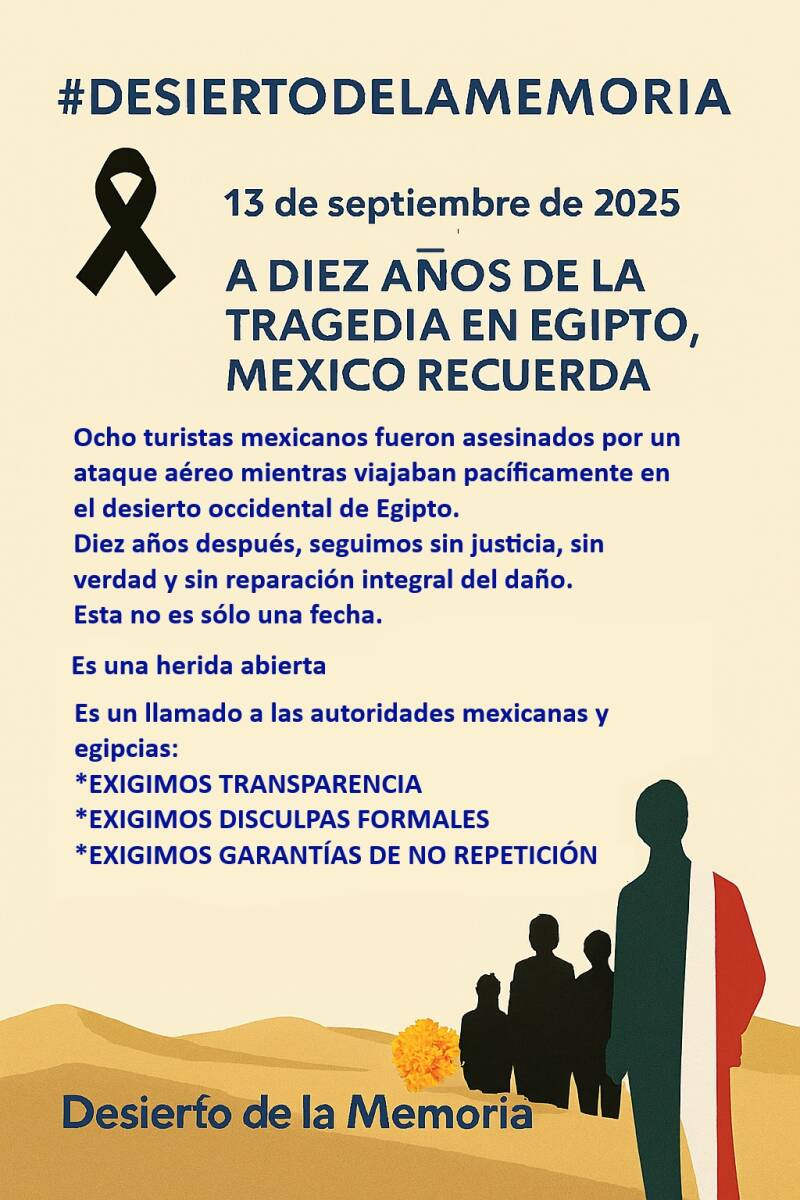
Este 13 de septiembre del 2026, conmemoramos el 11° aniversario del evento en el desierto egipcio en el 2015, con una emotiva misa en la ciudad de león, Guanajuato, donde vivía Israel González Delgadillo, uno de los fallecidos. Descansen en paz los que murieron y fortaleza a los sobrevivientes.

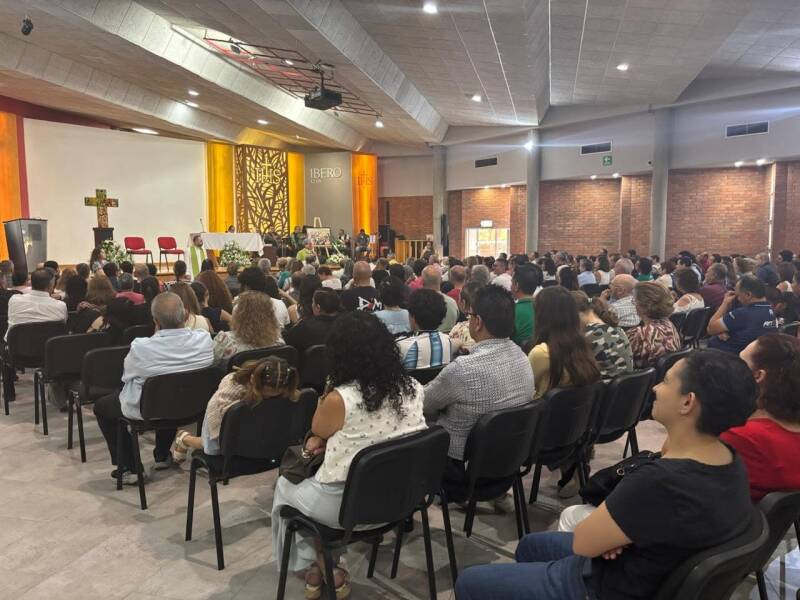
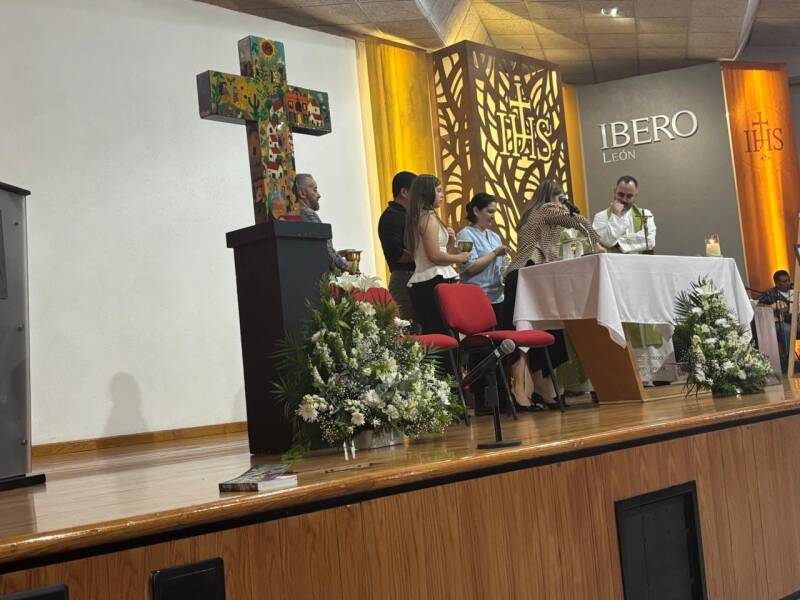
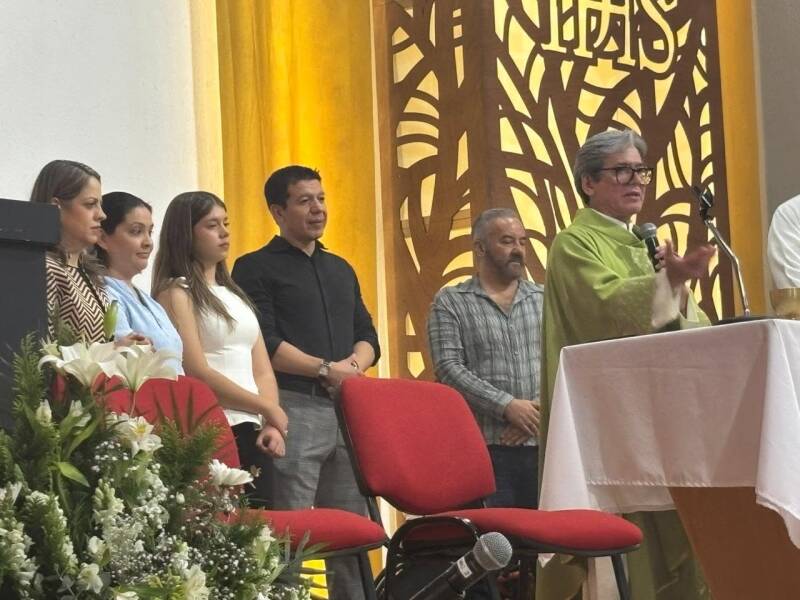
El miércoles 9 de septiembre, en la estación de radio RADIO METRÓPOLI de la ciudad de Guadalajara, el reportero José Luis Jiménez Castro realizó una entrevista sobre lo sucedido en el desierto de Egipto el 13 de septiembre del 2015.
En esta liga podrán escuchar la entrevista que nos hicieron en Radio Metrópoli el 9 de septiembre del 2026.